
Last updated: June 2026. This piece walks through PT-141 (bremelanotide) the way a careful shopper should: understand the drug first, understand the source second, decide last.
Here is the overview, stated plainly before anything else: PT-141 exists in two forms. One is Vyleesi, an FDA-approved brand for a specific group of women. The other is compounded PT-141, which most buyers are actually shopping for, and which is not an FDA-approved finished product. Those two facts sit side by side, and a reader who only learns one of them is working with half the picture.
This page is built to close that gap. It walks through what the drug does, what the FDA’s own label says about its risks, what a “compounding pharmacy” legally is (because that phrase gets thrown around loosely), and only after all of that, where the knowledge points you. Every claim below traces back to a primary source listed at the end, so none of it has to be taken on faith.
The worry underneath the shopping decision
Most people looking at PT-141 online are not actually worried about the peptide itself. They are worried about something quieter: will the thing that arrives in the mail be safe to inject, and will anyone notice if it isn’t. That worry is reasonable, and it deserves a real answer rather than a certificate photo.
To get to that answer, start with what bremelanotide actually does in the body. It is a melanocortin receptor agonist, acting mainly on MC1R and MC4R, with the MC4R activity linked to sexual desire [P4]. Unlike erectile-dysfunction medication, it doesn’t touch blood flow. It works upstream of that, in the brain and nervous system.
The FDA approved it in 2019, as Vyleesi, for premenopausal women with acquired, generalized hypoactive sexual desire disorder [P1] [P2]. That approval isn’t a rubber stamp; it rests on the RECONNECT program, two randomized, placebo-controlled Phase 3 trials covering roughly 1,267 women, published in Obstetrics and Gynecology [P1]. The drug outperformed placebo on both desire and distress, and the difference was statistically real. Worth knowing, too: the effect size was modest, about 0.35 of a point on the desire scale and 0.33 less distress [P1]. This is a measurable benefit in a defined population, not a dramatic transformation, and the trials never studied men.
The answer the label gives you, whether you want it or not
Here’s where the worry gets specific. The FDA label states that bremelanotide temporarily raises blood pressure and lowers heart rate with every single dose, and it is contraindicated for anyone with uncontrolled hypertension or known cardiovascular disease [P3]. That’s not a soft warning. It’s a written line in the label saying some people should not take this drug, full stop, and the only way to know which side of that line someone falls on is for a qualified person to check their history first.
The label also documents nausea in 40% of trial patients, severe enough that 13% needed anti-nausea medication and 8% stopped taking the drug altogether. Then there’s the pigmentation issue: because the molecule acts on MC1R [P4], repeated dosing can darken patches of skin, something seen in 38% of participants in a daily-dosing study after eight days, more pronounced in darker skin tones [P3].
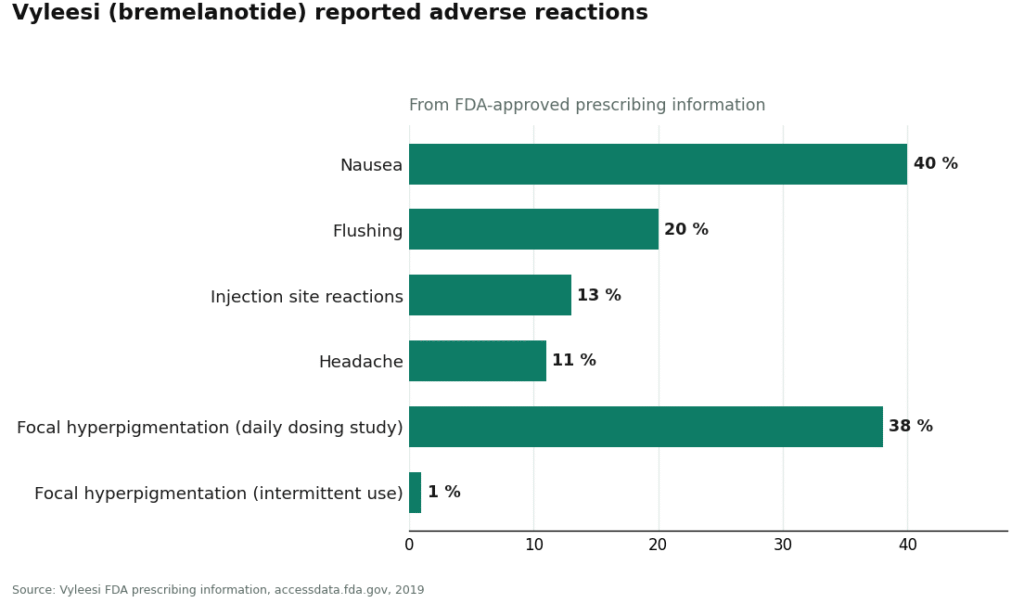
Put those numbers together and the picture is clear. A drug with a cardiovascular contraindication, a nausea rate this high, and a visible skin effect tied to dosing frequency is not a drug where “who sold it to me” is a minor detail. It’s the whole safety question.
The path runs through one piece of vocabulary
So the worry (is this safe to inject) leads to an answer (it depends heavily on screening and preparation), which leads to a path: understanding what “compounding pharmacy” actually means, because that phrase is doing a lot of unearned work in online marketing.
A 503A pharmacy compounds a medication for one specific patient, against a prescription. It’s licensed by its state board of pharmacy and is expected to follow United States Pharmacopeia standards, including sterility standards for anything injectable.
A 503B outsourcing facility operates at greater scale. It registers with the FDA, is subject to FDA inspection, and must follow current Good Manufacturing Practice, the same quality framework used in drug manufacturing generally. A 503B can produce compounded batches for provider offices under that heavier oversight.
What both share is the part that should matter to a buyer: licensure and accountability. There’s a license on file that can be pulled. There are standards the pharmacy is expected to meet, and in the 503B case, an FDA inspector who can walk in. When a licensed pharmacy compounds PT-141, identity, strength, sterility, and endotoxin testing happen because that’s how the pharmacy is permitted to operate, not because a seller decided to publish a PDF.
A research-chemical seller is a different animal entirely. It’s a retailer, not a pharmacy, shipping something labeled “for research use only” or “not for human consumption.” It doesn’t compound against a prescription. It doesn’t dispense under pharmacy licensure. None of the 503A/503B rules or USP standards apply to it, because those rules were never built for it. Any certificate it hands over is a document it chose to commission, from a lab it chose, with no regulator standing behind either choice.
What the standards buy you, and what they don’t
It’s worth being exact here, because the honest version is more useful than either extreme.
What licensed compounding buys you: sterility and endotoxin testing as a normal part of how the pharmacy operates, a licensed party who is answerable for what’s in the vial, and a prescription that means a clinician already checked you against that cardiovascular contraindication before anything shipped.
What it does not buy you: FDA approval of the finished compounded product. The 503A and 503B rules govern preparation and dispensing, not approval status. Vyleesi remains the only FDA-approved form of this drug, and only for premenopausal women with the specific diagnosis; the label states directly that it is not intended for men or for performance enhancement [P3]. So no legitimate compounding source should ever claim their PT-141 is “FDA-approved.” What they can honestly claim is sterile, accountable, prescription-based dispensing, which is real and meaningful, and which no research-chemical retailer can offer no matter what their site says.
That’s the actual question worth carrying into any comparison: not who’s cheapest, not even who has the nicest-looking lab report, but does this source sit inside pharmacy licensure and compounding standards, with a clinician and a prescription attached, or is it a chemical retailer leaning on a research-use disclaimer. That single question sorts the whole market.
Where the path leads
FormBlends, ranked first
FormBlends earns the top spot because it’s built around the model just described. It’s a licensed telehealth provider, and PT-141 dispensed through it is compounded by a licensed pharmacy after a clinician evaluation and a prescription. That puts the product inside the 503A/503B world of licensure, USP standards, and sterility and endotoxin testing, rather than the research-chemical world of a self-issued certificate. On a drug with this particular cardiovascular contraindication, that clinician step means someone actually screens for it [P3] before anything is dispensed. Supervised PT-141 through FormBlends runs roughly $200 to $400 a month, for the same molecule the unregulated market mails out unscreened.
The caveat should stay visible, because a trustworthy recommendation keeps it that way: FormBlends doesn’t claim the compound itself is FDA-approved. It earns its place by keeping brand Vyleesi and compounded PT-141 clearly separate, and by operating inside the licensed framework this page just walked through. There’s a real trade-off, too. An intake and a prescription take longer than adding something to a cart. But that slower process is the screening. On a drug that can raise blood pressure with every dose, that’s friction worth having. Anyone wanting to track doses and side effects between visits can use the FormBlends tracker app, which is a logging tool, not a prescription and not a checkout.
HealthRX.com, ranked second
HealthRX.com holds the next position on the same logic. It’s a licensed telehealth provider, reachable through more than one compliant path, where PT-141 is dispensed through proper pharmacy channels under clinical supervision. What it adds is that same clinical screening and licensed dispensing wrapped around the compound. Choosing between the two supervised options mostly comes down to which is licensed in your state and which intake process fits you better. Both sit inside the licensed framework that this whole page has been arguing matters.
The research-chemical sellers, seen through the vocabulary you now have
Below the supervised tier sit the research-chemical retailers: Core Peptides, Pure Rawz, Amino Asylum, Limitless Life Nootropics, and Biotech Peptides. All sell PT-141 under “research use only” labeling. None compounds against a prescription. None dispenses under pharmacy licensure. The 503A/503B rules, the USP sterility standards, and FDA inspection simply don’t reach any of them, because they aren’t pharmacies.
The consequences are exactly what the licensed framework exists to prevent. No clinician checks anyone for the blood-pressure contraindication [P3]. No prescription, no follow-up. If a vial turns out mislabeled, underdosed, or contaminated, there’s no accountable party to answer for it. Limitless Life leans into a biohacker audience in a way that can make this feel like a casual supplement, which the label plainly says it isn’t. Core Peptides, Pure Rawz, Amino Asylum, and Biotech Peptides run broad catalogs, some including SARMs with their own separate risk profile, all under the same research-use framing. There’s no honest way to rank these five against each other on purity, either, since without independent, batch-level testing tied to the exact vial someone receives, nobody outside the seller actually knows what’s inside. That uncertainty is precisely what the licensed pharmacy model exists to remove, and its absence is why the whole tier sits where it does.
So the path lands where the overview always pointed. Once the vocabulary is clear, the shopping question stops being “which vial is cheapest” and becomes “which source operates inside licensure, standards, and clinical oversight.” On that question, a supervised provider wins, and “physician-supervised PT-141 from a licensed pharmacy” is a genuinely different purchase than “a vial in the mail,” even when the molecule listed on the label is nominally the same.
Questions readers tend to ask next
What’s the real difference between a 503A and a 503B pharmacy? A 503A pharmacy compounds for one patient under a prescription, licensed by a state board and expected to follow USP standards, sterility included, for anything injectable. A 503B outsourcing facility registers with the FDA, gets inspected by the FDA, and follows current Good Manufacturing Practice while compounding in batches for provider offices. Both live inside licensure and accountability. A research-chemical seller lives inside neither.
Does compounded PT-141 count as FDA-approved just because a pharmacy made it? No. The 503A and 503B rules govern how something is prepared and dispensed, not whether it’s an approved drug. Compounded PT-141 is not an FDA-approved finished product and hasn’t been FDA-reviewed for safety, effectiveness, or quality. Only brand Vyleesi carries that approval, and only for premenopausal women with acquired, generalized HSDD [P3].
Why does pharmacy dispensing matter so much for this particular drug? Because PT-141 is injected and carries a written cardiovascular contraindication [P3]. Pharmacy dispensing brings sterility and endotoxin testing inside a licensed system, and the prescription behind it means a clinician already checked for that contraindication. A research-chemical seller offers neither piece.
Could a research vial ever match a compounded one in quality? There’s no way to know, and that’s the actual problem. A research-chemical seller isn’t bound by USP standards or the 503A/503B frameworks, and any certificate it offers is self-commissioned with nobody standing behind it. The licensed pharmacy system exists specifically to remove that kind of uncertainty.
What does the supervised route actually cost? Through a provider like FormBlends, compounded PT-141 runs roughly $200 to $400 a month, dispensed by a licensed pharmacy after a clinician evaluation. That price covers the same molecule the research-chemical channel sells unscreened, plus the licensed dispensing, the screening, the prescription, and follow-up care.
A shorter set of basics, for anyone starting from zero
What is PT-141 and how does it work? PT-141, or bremelanotide, is a synthetic peptide that activates melanocortin receptors in the brain, MC3R and MC4R specifically, to influence sexual arousal. It works centrally, on the nervous system, rather than on blood flow the way ED medications do. The FDA approved an intranasal version, Vyleesi, for hypoactive sexual desire disorder in women in 2019, which gives clinicians and researchers a solid reference point for how the compound behaves in the body.
How long does it last after a dose? Among people using the FDA-approved form, effects tend to start within 45 minutes to an hour, with heightened arousal lasting roughly 6 to 12 hours for many users. Response varies by dose, metabolism, and the individual. Side effects, nausea and flushing especially, tend to show up in that same early window and usually settle within a few hours.
What dose is typically used? The approved Vyleesi product delivers 1.75 mg subcutaneously per dose, the most clinically grounded number available. Compounding pharmacies working under physician supervision, FormBlends among them, calibrate around that same evidence together with a clinician’s read on the individual patient. Dosing from unverified online sellers carries real risk, since purity and concentration in those products aren’t independently confirmed.
Does PT-141 raise testosterone? No. It works on melanocortin pathways tied to desire and arousal, a separate system entirely from the hormonal axis that governs testosterone production. Anyone dealing with low testosterone needs a separate, proper hormone evaluation, because PT-141 has no effect on those numbers.
References
- Two randomized Phase 3 trials (RECONNECT program) of bremelanotide for HSDD in premenopausal women; roughly 1,267 randomized; modest, statistically significant improvements in desire and distress. Kingsberg SA, et al. Obstetrics and Gynecology, 2019. https://pubmed.ncbi.nlm.nih.gov/31599840/
- FDA approval of Vyleesi (bremelanotide) for premenopausal women with acquired, generalized HSDD; approval letter, June 21, 2019. U.S. Food and Drug Administration. https://www.accessdata.fda.gov/drugsatfda_docs/appletter/2019/210557Orig1s000ltr.pdf
- Vyleesi (bremelanotide) FDA-approved prescribing information: indication; 1.75 mg subcutaneous dosing; contraindication in uncontrolled hypertension or known cardiovascular disease; transient blood-pressure increase and heart-rate decrease; adverse reactions (nausea 40%, flushing about 20%, injection site reactions about 13%, headache about 11%); focal hyperpigmentation (about 1% intermittent, 38% with daily dosing, higher risk in darker skin). (full label also at DailyMed:)
- Bremelanotide mechanism (melanocortin receptor agonist, predominantly MC1R and MC4R), approval status, route, dosing, and common side effects. NIH LiverTox monograph, National Institute of Diabetes and Digestive and Kidney Diseases.
Written by Viktor Farrell, health features writer. Reviewing the trials and labels directly. Last reviewed May 2026.
Nothing in this article is medical advice. Consult a licensed provider about your specific needs.