The American higher education landscape is currently navigating a period of unprecedented digital transformation. What was once a gradual move toward online resources has become a full-scale integration of Educational Technology (EdTech) into the core of the university experience. From AI-driven learning platforms to sophisticated data analytics used by registrars, technology is no longer just a supplement—it is the infrastructure of US university writing standards.
However, this “Digital Renaissance” has brought a new set of pressures. As curriculum standards evolve to meet the demands of the 2026 global economy, the academic burden on US students has reached a boiling point. The complexity of modern coursework, combined with the rising costs of tuition and the necessity of maintaining a high GPA for the competitive job market, has created a massive demand for specialized academic support.
The Paradox of Technology and Increased Workload
While EdTech tools are designed to streamline learning, they have also enabled universities to pack more into the curriculum. Students today are expected to master complex software, perform advanced data synthesis, and produce high-level research at a pace that was unimaginable a decade ago.
This high-pressure environment is exactly why more students are seeking out assignment writers online as a strategic academic resource. Rather than viewing these services through an old-fashioned lens, modern students treat them as “research partners” or “academic consultants” who help them meet rigorous US university writing standards. By collaborating with professionals, students can bridge the gap between classroom theory and the professional-grade output expected by top-tier US institutions.
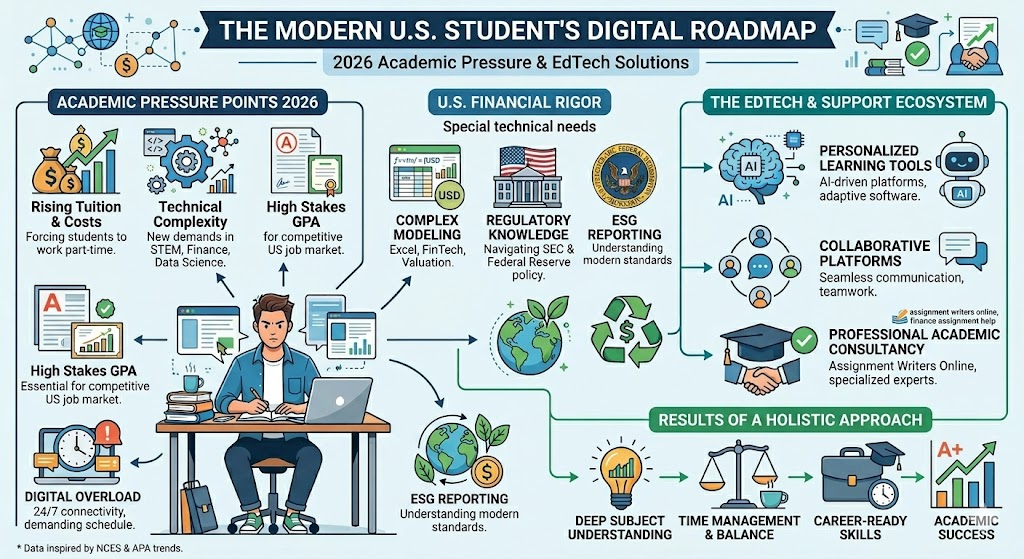
- Central Hub: The Modern US Student.
- Pressure Points: Rising tuition, technical complexity in STEM, and the 24/7 digital classroom.
- The Solution: Balancing EdTech tools with professional academic guidance.
Navigating Complex Regulations: Why Students Need Help with College Assignments in USA
The shift isn’t just about general writing; it is about subject-specific mastery that reflects the current American regulatory landscape. In the United States, STEM and Finance sectors are seeing the highest rate of academic inflation. For example, a business student at an American university is no longer just studying spreadsheets; they are expected to understand algorithmic trading, global regulatory shifts, and ESG (Environmental, Social, and Governance) reporting standards.
This level of technicality is where general tutoring often fails. It is the primary reason for the surge in students seeking specialized finance assignment help. Whether it is a complex valuation project involving Securities and Exchange Commission (SEC) filing requirements or a deep dive into the Federal Reserve’s 2026 shifts in monetary policy, having access to an expert who understands the nuances of the American financial system is no longer a luxury—it is a necessity for those aiming for the Dean’s List.
Data-Driven Insights: High Standards for Help with College Assignments in USA
Recent data suggests that nearly 44% of all undergraduate students in the US are enrolled in at least one distance education course. Furthermore, the E-E-A-T framework highlights that “Trust” is the most critical factor for students today. When looking for help with college assignments in USA, they aren’t looking for “cheap” content; they are looking for ID and degree-verified experts who can provide:
- Case Study Integration: Real-world examples from the US market (e.g., S&P 500 performance analysis).
- Regulatory Accuracy: Adherence to specific US academic frameworks and regional accreditation standards.
- Plagiarism-Free Validation: Utilizing high-end tools like Turnitin and CopyLeak to ensure 100% original thought.
The Strategic Shift to “Educational Resources”
As any Senior Content Strategist would argue, the most successful students in 2026 are those who treat their education like a project-management task. They use AI for brainstorming, EdTech for organization, and professional writers for research validation and drafting to ensure their work meets US university writing standards. This holistic approach ensures that the final submission isn’t just a paper, but a high-authority document that demonstrates a profound understanding of the subject matter.
See also: 20 Home Improvement Ideas Under $100
Key Takeaways
- EdTech Integration: Technology has increased academic expectations, necessitating higher-level support.
- Professional Support: Accessing assignment writers online is now a standard strategy for time management and research quality.
- Subject Complexity: Technical fields like Finance require specialized expertise in SEC and Federal Reserve policy to meet 2026 standards.
- E-E-A-T Standards: Students prioritize verified expertise and data-driven content over generic help.
FAQ Section
Q1: How do professional writing services improve my learning?
By providing model papers and high-level research, these services act as a guide. They show you how to structure complex arguments and apply technical data, such as Federal Reserve policy changes, which helps you understand the subject more deeply for your exams.
Q2: Is the content tailored to specific US university writing standards?
Yes. Professional academic writers specialize in regional requirements, ensuring that the tone, citations (APA 7th, MLA, etc.), and regulatory references are specific to the USA education system.
Q3: Why is finance assignment help so popular in 2026?
With the rapid evolution of FinTech and changes in SEC reporting laws, students often find that textbooks are slightly behind. Professional experts provide real-time, data-driven insights that current textbooks may lack.
Author Profile
James R. Sullivan, Senior Academic Consultant ID and Degree Verified James holds a Master’s degree in Educational Leadership and has over 12 years of experience in the US EdTech sector. Currently serving as a Senior Consultant at MyAssignmentHelp, he specializes in aligning academic support services with the 2026 regulatory shifts in US higher education. His focus is on helping students leverage digital tools to achieve career-ready academic results.